Leapfrogging Care? What Medical Drones Are Doing to Public Health Governance in Africa

An ethnographic view from Ghana and Malawi on what African health systems should prioritise next
This piece draws on four years of comparative ethnographic research in Ghana and Malawi, between 2021 and 2025. I want to make three connected arguments for the people who shape African health governance: ministries, regulators, and the advisory bodies behind them. First, medical drones do not bypass infrastructure. They reassemble it. Second, Ghana and Malawi have taken divergent paths, and this divergence shows that "leapfrogging" is not a single pathway. It is a set of political choices, each producing a different infrastructural future. Third, the leapfrogging imaginary circulates through an elite network of donors, platform companies, consultants, and technocrats. It tends to serve their interests, even when individual programmes deliver real public-health gains.
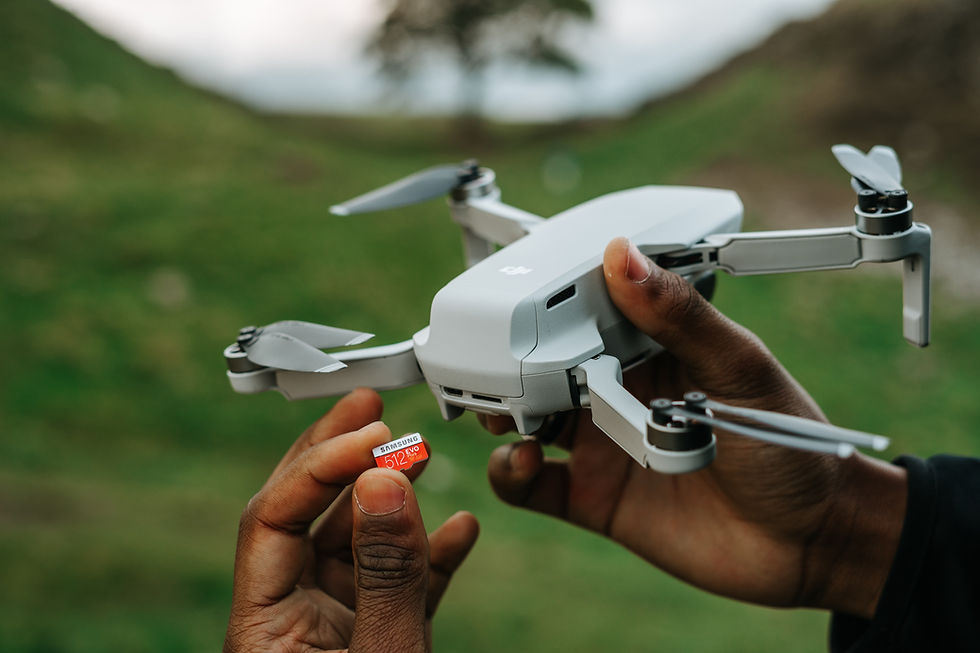
In a rural district in northern Ghana, a clinician orders a unit of blood. It arrives by drone, operated by Zipline, on average within about thirty minutes. In Kasungu, central Malawi, a UNICEF-supported drone testing corridor has been pivotal in enhancing laboratory diagnostics through transportation of biological samples, vaccube dekuverues, and emergency medicies to the last mile. Both stories circulate as ligitmating proof of an African health-system leapfrog. Poor road infrastructure bypassed by unmanned autonomous vehicles (UVAs). The last mile (SDGs agenda to ensure access to health coverage to the underserved) disenfranchisement/marginalisatioin, solved by algorithmic intervention. Vaccines delivered with the precision of e-commerce, prudent resource utilisation in largely underfunded settings and cost effectiveness.
These accounts are not false but partial. And the partiality is doing political work.
The imaginary and its political work
The medical drone is one of the most polished sociotechnical imaginaries in African development discourse. The term comes from Sheila Jasanoff and Sang-Hyun Kim, who use it to describe how societies project desirable futures through technology. It is useful here because the drone is imagined as four good things at once: efficient, life-saving, data-driven, and sustainable. Each adjective does work. "Efficient" answers the supply-chain critique. "Life-saving" foregrounds emergency uses that are hard to argue against. "Data-driven" reassures donors. "Sustainable" pre-empts the climate question with electric propulsion. Sustainability preempts the long duree of these UAVs in these perennially underfunded healthcare settings and the also the climate.
Stacked together, those four adjectives make the technology look like a substitute for harder political questions. Who governs? Who labours? Who owns the data? Who depends on whom? That substitution is what should put governance actors on alert. Imaginaries like this do not emerge from nowhere. They are produced and circulated by an interlocking set of actors: platform companies headquartered in California and Darmstadt, multilateral donors, philanthropic foundations, ministerial technocrats, and a growing layer of consultants who move between them. Their conferences, white papers, and pilots carry the promise.
Making this circuit visible is not a refusal of the technology. African states are not passive within it. But the more honest the account of who benefits from the leapfrog framing, politically, financially, and reputationally, the better positioned governance actors are to negotiate on their own terms.

Two trajectories, two political settlements
Ghana and Malawi are routinely grouped together as African early adopters. In fact they are doing quite different things.
Ghana has stabilised drones as state infrastructure. A centralised public-private partnership with Zipline has folded drone delivery into the national health supply chain. Blood products, vaccines, anti-snake venom, and emergency medicines now move routinely to remote facilities. Visibility into underserved regions has improved. But the system is also locked into the architecture of a single American platform company. Data formats, pricing power, system knowledge, and operational continuity sit largely with the vendor. This is not a partnership of equals. It can still be worthwhile. Its terms decide whether the gains prove durable or merely contingent.
Malawi has institutionalised experimentation itself. The UNICEF-supported corridor in Kasungu has hosted multiple operators. Swoop Aero and Wingcopter have run pilots across the country, working on diagnostics, vaccines, and humanitarian logistics. The model is more pluralistic and less locked-in. It is also more fragmented, donor-driven, and temporary. Pilots end. Corridors lose funding. The health system does not automatically keep the capacity or knowledge generated. Where Ghana risks dependency, Malawi risks evaporation..
Neither model is wrong. Both are political settlements with different trade-offs, and the policy task is to be deliberate about which settlement is being chosen and on whose terms.
What gets reassembled
Once we describe drones as reassembling infrastructure rather than bypassing it, three priorities move to the centre of governance.
Labour justice. Drone systems generate new technical roles: pilots, swap-pod operators, logistics coordinators, digital health managers. These workers are not community health workers. They are not always covered by the protections that apply to traditional health staff. As these workforces grow, governance actors should treat them as part of the public health labour system, with training pipelines, union rights, career pathways, and a clear regulatory home. Who gets these jobs, and on what terms, will decide whether drones build local technical capacity or simply add a precarious tier of platform labour.
Data sovereignty. Every delivery generates data. Data about patients, facilities, demand patterns, clinical practice, and population movement. Where that data lives, who can analyse it, what products can be built from it, and who profits are governance questions with long tails. Platformised care does not announce itself. It accumulates through contracts whose data clauses rarely reach public debate. African states have a narrow window to insist on data localisation, joint analytical capacity, and clear limits on secondary commercial use before the defaults are set.
Material sustainability. "Electric" is not the same as "low-impact." Drone fleets depend on lithium batteries, fragile rural energy systems, and transnational supply chains for spare parts. Those batteries also depend on cobalt, and roughly three-quarters of the world's cobalt is mined in the Democratic Republic of Congo. The environmental costs are real. They are simply externalised, borne by mining communities, national grids, and waste streams. Green-transition claims need life-cycle accounting, not point-of-flight accounting.
What to prioritise
For governance actors, the practical priorities differ by setting but rhyme in substance.
In contractual contexts like Ghana. The need to insert exit options or clauses and renegotiation rights into long-term agreements. Insist on data portability and joint ownership. Require transparent pricing reviews. Mandate the transfer of operational knowledge to national institutions. Tie performance metrics to equity, not volume alone. The question is not whether to contract with platform companies. It is how to do so without foreclosing future sovereignty.
In experimental contexts like Malawi. Plan for sunset from day one. Make the absorption of skills and infrastructure into national systems a condition when pilots end. Coordinate donors so projects do not duplicate or compete. Set clear rules on who keeps the data and intellectual property generated during testing. Experimentation is valuable. Experimentation without institutional residue is extractive.
Across both settings, one thing holds. Drone-enabled health logistics should be treated as a public-utility question, not merely a technological one. A public budget line, even a modest one, signals that the system is part of the state's responsibility, not a permanent gift from elsewhere
Making the politics visible
The deepest contribution governance actors can make is to keep the political character of these systems in view. Medical drones are not magic. They are not neutral. They are political infrastructures in technical clothing, embedded in a circuit through which promises travel and through which contracts, careers, and capital flow.
Naming that circuit is not a rejection of innovation. The gains in access are real. Dismissing them would be unfair to the health workers who make the systems function every day. The point is harder and more useful. African states are best served when innovation narratives meet the same scrutiny as any other political claim. The leapfrog is a metaphor, and it does work, in the rooms where decisions are made.
If we are serious about equitable digital and green futures in African health, the question is not whether to fly. It is who governs the sky, who owns the data, who repairs the battery, and who is in the room when the next contract is signed.

DISCLAIMER: The views expressed in this blog are those of the author and do not necessarily reflect the official position of Governance and Development Advisory, or any institution with which the author is affiliated. This piece is written in a personal capacity to contribute to critical dialogue on Health Governance in Africa.



Comments