"The Policy Coherence Trap": South Africa's Next Industrial Policy Challenge

Updated: Sep 30
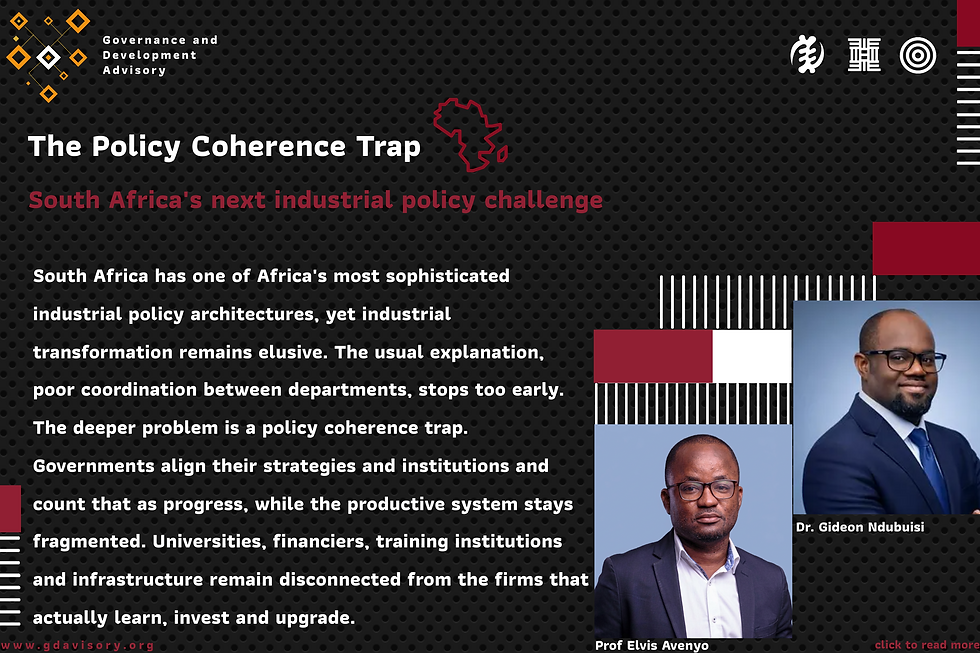
South Africa has one of Africa's most sophisticated industrial policy architectures, yet industrial transformation remains elusive. The usual explanation, poor coordination between departments, stops too early. The deeper problem is a policy coherence trap. Governments align their strategies and institutions and count that as progress, while the productive system stays fragmented. Universities, financiers, training institutions and infrastructure remain disconnected from the firms that actually learn, invest and upgrade. As decarbonisation, digitalisation and the critical-minerals race collide, the cost of fragmented systems is rising. The next frontier is not more strategies and committees, but system coherence and capabilities.

Industrial policy is back, and Africa is no exception. Across the continent, governments are once again turning to industrial strategies to promote value addition, technological upgrading, localisation, digital transformation, and green industrialisation while seeking to move domestic firms into higher-value segments of global value chains. This marks an important shift from the market-centred policy orthodoxy that dominated much of the 1980s and 1990s. Industrial transformation is increasingly understood as something that requires deliberate state action, not simply better markets.
South Africa exemplifies this evolution. It possesses one of Africa's most comprehensive industrial policy architectures. Alongside the Industrial Development Strategy sit the STI Decadal Plan, localisation strategies, digital economy frameworks, science and technology policies, industrial master plans, critical minerals initiatives, green hydrogen strategies and various financing programmes. Viewed individually, many of these policies are well designed. Collectively, however, they raise a more important question.
If industrial policy is now more sophisticated, why does industrial transformation remain so elusive in South Africa? Part of the answer is familiar: policy fragmentation. Departments pursue competing objectives. Institutions operate in silos. Strategies are poorly coordinated. These problems are real, but the diagnosis often stops too early.
The deeper challenge is not simply whether government policies are coherent. It is whether the productive systems through which industrialisation occurs are coherent.
Beyond policy coherence
Policy coherence concerns the alignment of government strategies, institutions and objectives. It matters for industrialisation: industrial, trade, innovation, energy, competition, fiscal and skills policies cannot work effectively if they pull in contradictory directions. But policy coherence is a necessary condition for industrial transformation, not a sufficient one.
Industrialisation ultimately depends on what happens within the productive system. Firms must learn and innovate. Suppliers must upgrade. Engineers must solve production problems. Universities and research institutes must connect knowledge to industrial needs. Financial institutions must support technological investments. Infrastructure must enable production, while procurement and other demand-side instruments create markets in which domestic capabilities can develop.
Industrialisation, in other words, happens inside interconnected systems.
This is what we mean by system coherence: the extent to which production, innovation, skills, finance, infrastructure and markets are sufficiently connected and mutually reinforcing to support firm-level learning and capability accumulation. The distinction between policy coherence and system coherence matters decisively.

A country can improve policy alignment while these productive relationships remain weak. Universities may generate knowledge that firms cannot absorb. Innovation agencies may finance research with limited connection to production. Development finance may provide capital without the complementary technical capabilities required for upgrading. Training institutions may produce qualifications that do not match changing industrial demand. Procurement may increase domestic purchasing without stimulating supplier learning. Industrial strategies may identify promising sectors without ensuring reliable energy, logistics, technological capability or sustained demand.
This creates what we call the policy coherence trap: mistaking greater coherence among policies and public institutions for coherence within the productive system itself.

The trap becomes self-reinforcing when disappointing industrial outcomes are repeatedly diagnosed primarily as failures of policy coordination. Governments respond with new strategies, committees and alignment mechanisms, while the underlying constraints on firm learning, technological upgrading and productive capability remain unresolved. The problem is thus not that coordination is unnecessary. It is that coordination becomes an end rather than a means to building productive capabilities.
South Africa's deeper challenge
South Africa illustrates this trap particularly well. The country combines a dense and sophisticated policy architecture. Yet its manufacturing productivity remains subdued. Technological upgrading has been uneven. Commercialisation of research remains limited. Many firms struggle to absorb new technologies, while manufacturing's contribution to employment and output has steadily declined.
The explanation is not simply that government departments fail to coordinate. The deeper challenge is that the systems responsible for generating productive capabilities remain fragmented. Research institutions frequently generate knowledge that does not reach production. Innovation agencies support research but often remain disconnected from firms' technological needs. Development finance institutions provide capital, but not always the complementary support required for capability building. Skills institutions continue to struggle to align training with rapidly changing industrial demand. Procurement systems rarely function as strategic instruments for technological learning and domestic industrial upgrading.
Each institution may perform reasonably well within its own mandate. Yet industrial transformation depends less on the performance of individual institutions than on the strength of the relationships between them.
The critical question facing the country is thus not simply whether industrial policies are coherent. It is whether they connect the institutions, capabilities, and productive actors through which industrial transformation actually occurs.
When transitions collide
The need for system coherence is more urgent than ever, as industrial transformation now occurs amid several overlapping transitions. Decarbonisation is reshaping manufacturing and trade. Artificial intelligence and digital technologies are altering production systems. Critical minerals are becoming strategically important. Carbon standards and green subsidies are changing competitive conditions in major markets.
These transitions are no longer unfolding independently. They are colliding. This dramatically increases the cost of fragmented industrial systems.
A renewable-energy manufacturing strategy, for example, cannot succeed through localisation targets alone. It requires reliable deployment pipelines, engineering capabilities, supplier development, access to technology, finance, skills, infrastructure and sufficient domestic or regional demand.
Likewise, a critical-minerals strategy that demands beneficiation without aligning electricity supply, logistics, technological capabilities, finance and downstream markets risks producing ambitious policy on paper but little transformation in practice.
Managing these interacting transitions requires something more ambitious than policy coordination. It requires system coherence.
Capabilities, not committees
What does this mean for policymakers? The first priority is to move beyond coordination by committee to coordination by problem-solving. Industrial policy should be organised around concrete productive ecosystems and identifiable bottlenecks. Instead of asking whether all relevant departments sit on the same committee, governments should ask whether institutions can jointly solve the technological, financial, infrastructure, skills and market constraints preventing firms from upgrading.
Second, industrial policies must become fully embedded within productive transformation. Universities, research institutions, technology centres, financiers and firms should not operate as parallel systems. They must become part of a common capability-building architecture.
Third, industrial policies must also become directional. Governments need to provide a credible orientation for industrial transformation by identifying priority technological and industrial trajectories, signalling long-term state commitment, and mobilising complementary institutions, resources, and capabilities around their realisation.
But directionality also requires political economy. Institutions frequently pursue different objectives. Firms may prefer importing established technologies to investing in local learning. Universities respond to academic incentives. Financial institutions manage risk. Fiscal authorities face budget constraints. System coherence requires mechanisms that reconcile competing incentives, not merely placing different actors in the same room.
Finally, governments need to rethink how they measure industrial success. Too often, industrial policy outcomes are evaluated through inputs such as research expenditure, patents, publications or the number of programmes launched. These indicators remain useful, but they reveal little on their own about whether productive capabilities are accumulating.
The harder questions are more important. Are firms adopting more advanced technologies? Are domestic suppliers meeting more demanding standards? Is productivity increasing? Are firms producing more sophisticated products? Is domestic value capture rising? Are firms becoming more competitive internationally? These are the outcomes that ultimately matter.
South Africa's experience points to a wider challenge facing Africa's industrial transformation. The continent's next challenge is not simply to produce more strategies. It is to strengthen the mechanisms through which existing strategies generate productive capabilities. The next frontier of industrial policy is therefore not to abandon policy coherence. It is to go beyond it toward system coherence.
Countries are far more likely to industrialise when finance, technology, skills, infrastructure, production and markets reinforce one another sufficiently for firms to learn, invest and upgrade.
For South Africa, and increasingly for other African economies, the real challenge is not policy production. It is productive and technological capability accumulation. This is the challenge facing South Africa and African economies more broadly, as they seek not only to industrialise, but to do so in a world being reshaped by technological change and the green transition.
DISCLAIMER: The views expressed in this blog are those of the authors and do not necessarily reflect the official position of Governance and Development Advisory or any institution with which the authors are affiliated. This piece is written in a personal capacity to contribute to critical dialogue on industrial policy in Africa.


Comments